There are events that not only bring people together. They also bring together symbols, trajectories, territory, and memory. The 2026 Lucrècia Awards of Honor, held at the Principal Theater in Inca, were one of those moments: a cultural event promoted by cultural manager Jaume Gomila and dedicated this year to recognizing the contribution of Menorcan actresses Laura Pons and Àngels Gonyalons to the performing and audiovisual arts. For such an occasion, gastronomy could not simply be an accompaniment. It had to be part of the story.
A proposal born from a specific request
The commission stemmed from a very special idea: creating a gastronomic proposal inspired by the Receptari Caules. Cuina menorquina del segle XVIII (Menorcan Cuisine of the 18th Century), a work linked to Menorcan culinary tradition and one of the first documented references to mayonnaise sauce. From there, the team at La Alacena de Genestra, under the direction of Andreu Genestra, worked to turn that request into more than just a menu: a meaningful gastronomic concept, capable of connecting the event with history, territory, and Balearic identity. Because for La Alacena, every event says something about who organizes it. And food, although it may sometimes seem like a detail, is one of the most direct ways of transmitting care, intention, and memory.
18th-century Menorca, reinterpreted for a modern cocktail
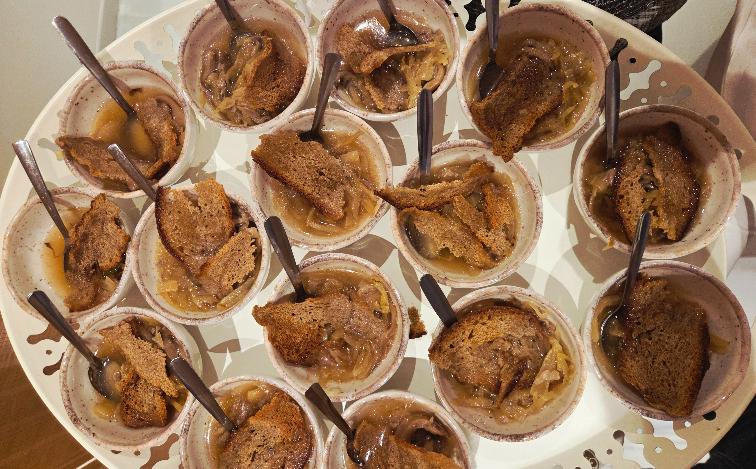
The proposal was built upon traditional Menorcan recipes reinterpreted into appetizer and cocktail formats. The goal was to maintain the historical roots of the elaborations while adapting them to the pace, format, and experience of a contemporary event. Among the pieces served were dishes such as coca proto in sauce, hen in sauce, Menorcan escudella, stewed quail, pickled cod, meatballs with sauce, bread soups, prepared egg, and tocino de cielo as a conventual dessert. Every bite was designed to transport the guest to a cuisine with roots, without falling into nostalgia. A cuisine that looks to the past to build a modern experience, precise and coherent with the institutional and cultural tone of the event.
More than catering: building peace of mind
At the Lucrècia Awards, La Alacena de Genestra once again demonstrated one of its main abilities: listening to the client, understanding what needs to be conveyed, and turning that intention into a complete gastronomic experience. It wasn't just about serving well. It was about everything being up to par: the idea, the menu, the pace of the service, the cultural context, and the guests' experience. This is precisely how La Alacena views its work. An important event always involves expectations, pressure, and many details that cannot fail. Therefore, beyond the cooking, what the team brings is peace of mind: the certainty that every element is thought out, cared for, and coordinated so that the result aligns with what the client wants to project.
A cuisine with history, craft, and territory
The participation in the Lucrècia Awards perfectly summarizes La Alacena de Genestra's way of working: starting from a specific need, contributing gastronomic judgment, and building a tailor-made proposal. In this case, the inspiration drawn from the Receptari Caules allowed building a bridge between historical Menorcan cuisine and the current language of catering. A way to prove that tradition and innovation are not opposing paths, but two ingredients that can coexist when there is craft, sensitivity, and a clear idea behind it. The result was a proposal designed to leave a good taste in the mouth, but also to reinforce the meaning of the event. Because when gastronomy is well-planned, it doesn't just accompany: it also tells a story.
Everything, up to the standard of what was meant to be conveyed
The Lucrècia Awards were a celebration of culture, Menorcan talent, and shared memory. The gastronomic proposal from La Alacena de Genestra aimed to be at that very same level, reinterpreting Menorca's culinary legacy from a contemporary perspective and taking care of every detail so that the experience flowed naturally. It’s an example of how catering can be much more than a practical solution. It can be a tool to build a narrative, reinforce identity, and ensure that an event transmits exactly what it intends to transmit.
Because at an important event, food is not just food. It is part of the memory that remains.
Tailor-made gastronomic experiences